Before the “Miracle” Of 1980, There Was Mickey Lolich
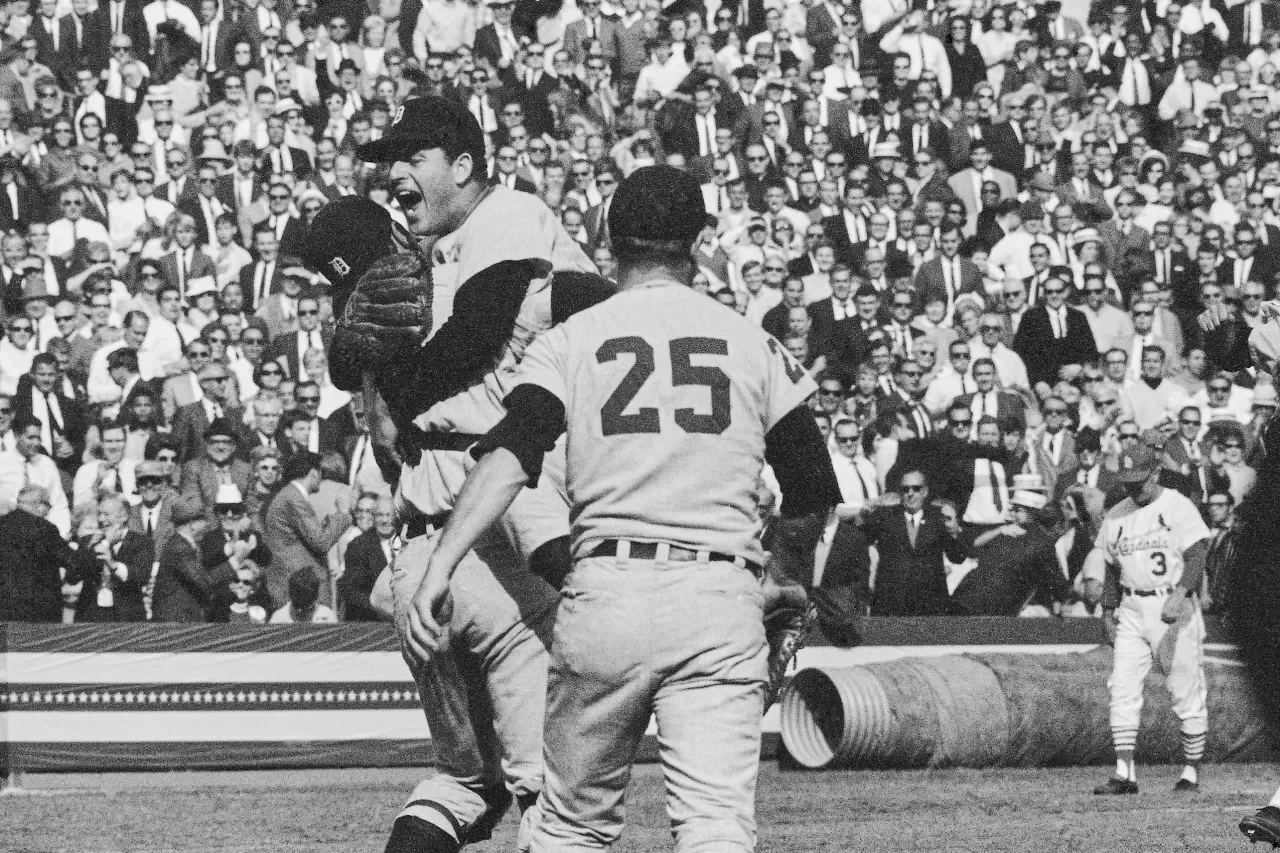
Mickey Lolich jumps into the arms of Bill Freehan after beating Bob Gibson and the Cardinals in Game 7 of the 1968 World Series at Busch Stadium.
Everyone is keenly aware of the 1980 “Miracle On Ice.” The current Winter Olympics have brought that episode back in view, and an excellent documentary on that unforgettable event - Miracle The Boys Of ’80 - is making the rounds on Netflix.
When it comes to upsets, all things considered, that occurrence probably tops them all. And before the reader suggests something more deserving - like the Blues winning Game 7 in Boston in 2019 - note the operative word in the statement is "probably."
But long before those hockey games there was a similarly stunning upset in Sports, one that still throbs. St. Louisans were reminded of it recently with the passing of Mickey Lolich at the age of 85.
Mickey Lolich … The name pierces the lips the way “Niagara Falls” does in the old Three Stooges clip, dark, ominous.
In overview, Lolich was a fine big league pitcher who had a heckuva career - most of it spent with Detroit. He achieved - if that’s the right word - baseball singularity in 1970-71, leading the American League in losses (19) in ’70, then leading in wins (25) in ’71.
It takes a good pitcher to collect so many losing decisions. For instance, Steve Carlton led the NL with 27 wins in 1972, then led the league with 20 losses in 1973. It was a “Reverse Lolich.”
But for this examination, Lolich has another distinction, and it remains a crack in the bat upon which the redbirds are perched. That is, he is the only pitcher to beat Bob Gibson in a World Series Game 7.
Busch Stadium, Oct. 10, 1968 ... “Slowly I turn, step by step …”
***
To elaborate, Lolich beat the '68 version of Bob Gibson, the one with a record-setting 1.12 earned-run average and 13 shutouts during the regular season, the one with seven consecutive complete game World Series wins, the one who allowed one run and fanned 27 Tigers in two previous starts. Think about that - half of the 54 outs Gibson had recorded were strikeouts. His ERA for the year had been lowered to 1.08.
It was indisputable - if. the Series went to Game 7, Gibson was gold.
He was at the height of his powers, the quintessential intimidator, the NL Cy Young winner and MVP. The idea that the Tigers, 103 regular season wins notwithstanding, and their portly lefthander might prevail on that Thursday afternoon in St. Louis was cockamamy. There weren’t enough psychedelic drugs on the Washington University campus at the time to produce that hallucination.
Not to disparage Lolich. But he ranked No. 3 on Detroit’s fine staff, which was headlined by 31-game winner Denny McLain and veteran Earl Wilson, who had 22 wins in ’67. Lolich finished 17-9 during the season, with eight complete games; he was no joke. But he pitched so poorly in August, he was pulled from the rotation and sent to the bullpen. Bottom line, he didn’t have a reputation anything like the Cardinals’ ace.
Still, Cardinals outfielder Roger Maris knew Lolich from his days as a New York Yankee. Before the Fall Classic began, he warned his teammates: “If you don’t pay attention to the fat guy he’ll shove the ball right up your (expletive).”
And he did.
***
Gibson manhandled the Tigers in Game 1, beating McLain and striking out a record 17, suggesting the Fall Classic was a forgone conclusion. But Lolich answered in Game 2, leading Detroit to an 8-1 win, striking out nine and hitting a home run off Nelson Briles. For lack of a better description, it was Gibson-like.
However, the reigning champions reasserted themselves. They won the next two games in Detroit, beating Wilson and McLain, outscoring the Tigers 17-4. Lou Brock, a World Series force of nature, came to the forefront. Over 21 postseason games, Brock batted .391 with 13 extra-base hits, 13 RBIs and 14 stolen bases. American League teams had never seen anything like him, and the Tigers saw a lot of him in those two games.
Brock had three hits and three steals in Game 3, a 7-3 Cardinals win. He added three more hits and a homer in Game 4, while Gibson homered and struck out 10 during a 10-1 beatdown. The Cardinals were back in command, leading the Series 3-1 and hitting on all cylinders.
Then came an improbable pivot, a moment where Brock went from World Series G.O.A.T. to World Series goat, a moment that set the Game 7 wheels in motion.
***
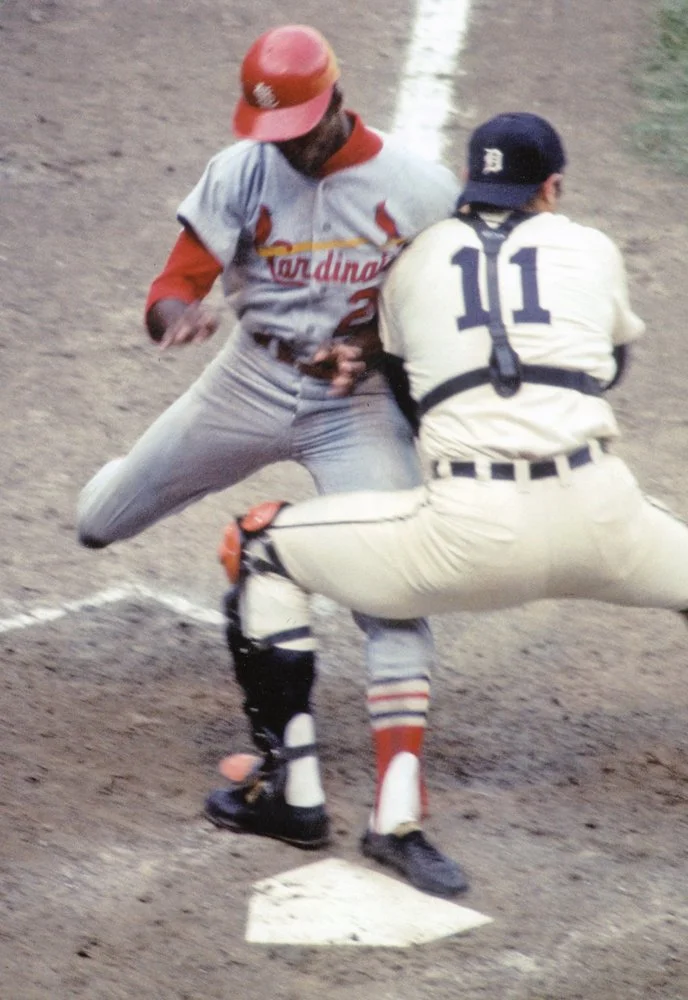
Riding momentum, the Cardinals reached the “fat guy” for three runs in the first inning of Game 5, two on Orlando Cepeda’s home run. When the top of the fifth arrived, the visitors still led 3-2 and threatened to add on. Brock doubled to left with one out and southpaw slaying Julian Javier followed with a single.
Because Javier’s line drive passed through the area of shortstop Mickey Stanley, Brock momentarily paused at second before sprinting for home. Detroit’s left fielder Willie Horton, a productive slugger, was something less than gifted as an outfielder - think Greg Luzinski. But Horton had been signed as a catcher and possessed a good throwing arm, good enough to make the play of his life.
He fielded the ball cleanly and uncorked a his throw without breaking stride. As catcher Bill Freehan stood at the plate, the one-hop throw reached him chest high, a split second before the baserunner.
For his part, Brock had a philosophy about sliding home. Because it is, like first base, a station you can run past without penalty, he believed it was more efficient to step to it without breaking stride. The Tigers had studied the scouting reports, they were aware.
"I had a good arm and I knew I could throw guys out,” Horton told the Detroit Free Press years later. “He came in standing up and didn't slide. And that's what made the play."
Brock reached for the plate with his left foot, colliding with Freehan as the catcher applied the tag. The home plate umpire was none other than Doug Harvey, who Whitey Herzog liked to call “God,” and not affectionately. Harvey called Brock out, as the Cardinals erupted in protest. For the rest of his life, which ended in 2020, Brock insisted otherwise.
“Safe,” Brock told me in 2016. "The ball went over Mickey Stanley's head at short, which caused me to … I did not get the kind of jump I would have, but I thought I could make it anyway.
“But Willie Horton made the throw of his life; I never thought Horton could make that throw. The next thing I knew I was about to collide with Bill Freehan, and we all know who would have won that. So I moved to avoid the collision and stuck my foot in there. I was safe, but the umpire said I was out … So I was out.”
Instead of a 4-2 lead and a productive inning percolating, the surge dissipated and the score remained 3-2. Paroled, Lolich kept the lid on and the Tigers - who came from behind to win 28 times that season - rallied for three in the seventh to win 5-3. Revitalized, they thumped the Cardinals in Game 6 back in St. Louis, scoring 10 in the third inning and winning 13-1 behind McLain.
But if you were of age, and you were aware, the turn of events was only disappointing, not foreboding. Because Gibson was in the chute, strapped in, nodding his head. The Tigers proved they belonged, did themselves proud, tip of the cap and all that. But now it was Game 7, and it was Gibson taking the ball.
Checkmate!
***
What happened instead on that Tuesday afternoon is still hard to square. Everything was going according to script, initially. Gibson struck out six of the first 12 Tigers he faced. Through six innings he allowed no runs and only one hit, an infield single by Stanley. He was Gibson, he was dominating.
Problem was, operating on just two days of rest, so was Lolich.
Through six, he also was unblemished. And when he got in a bit of trouble in the sixth, allowing singles to Brock and Flood, he picked both of them off base - both of them!
Something was going on.
The game went to the seventh and the unimaginable happened. With two outs, Detroit dinged Gibson for singles by Norm Cash and Horton. Then the next batter, Jim Northrup, banged the first pitch to center field.
Center field was Flood’s territory, the place flying baseballs went to die. He was the premier center fielder in the game during the 1960s, setting a major league record for consecutive games (226) and total chances (568) without an error. He was a Sports Illustrated cover, a Game 7 veteran playing in his own backyard. In the name of everything that is holy, it should have been an inning-ending out.
But something was going on.
Flood reacted in a way in which this scribe never saw before or after - he misjudged Northrup’s drive and stumbled trying to recover. Instead of the third out, a fly ball Flood puts in his back pocket sailed over his head for a two-run triple.
Jack Buck described Kirk Gibson’s dumbfounding homer in Game 1 of the 1988 World Series by saying, “I don’t believe what I just saw.” Cardinals fans knew the feeling. Been there, done that, 20 years earlier. Actually, it was worse than that. It was like being tased before there were tasers.
When Freehan doubled for a fourth consecutive hit, it was 3-0 and the Tigers made it 4-0 in the top of the ninth. Meanwhile, short rest and all, Lolich was sailing. By the time the Cardinals batted in the bottom of the ninth, he had hurled 16 consecutive scoreless innings since Game 5.
With two outs in the ninth, Mike Shannon registered one last challenge, hitting a home run over the left field wall. But Tim McCarver popped the next pitch to the catcher and it was over. Detroit had its first World Series championship in 23 years and Lolich had done the unthinkable - out-dueled Gibson on the road to win Game 7.
***
It’s unlikely Mickey Lolich ever will reside in Cooperstown. He didn’t get much support during his years of eligibility. But he won 217 games, including more than 20 in a season twice. He finished second in Cy Young voting twice, and third twice. He collected 2,832 strikeouts and pitched more than 300 innings in a season four times.
And in 1968, he beat the Cardinals three times. He became the MVP of the World Series by beating the 1967 World Series MVP in Game 7. He shattered the invincibility of baseball’s most invincible pitcher and broke the heart of a certain 15-year old Cardinals fan.
"It was always somebody else," Lolich told the Detroit Free Press in 2018, "but (in ’68) my day had finally come."
Cooperstown be damned. St. Louis will never forget Mickey Lolich.