Dick Hughes Made It After All
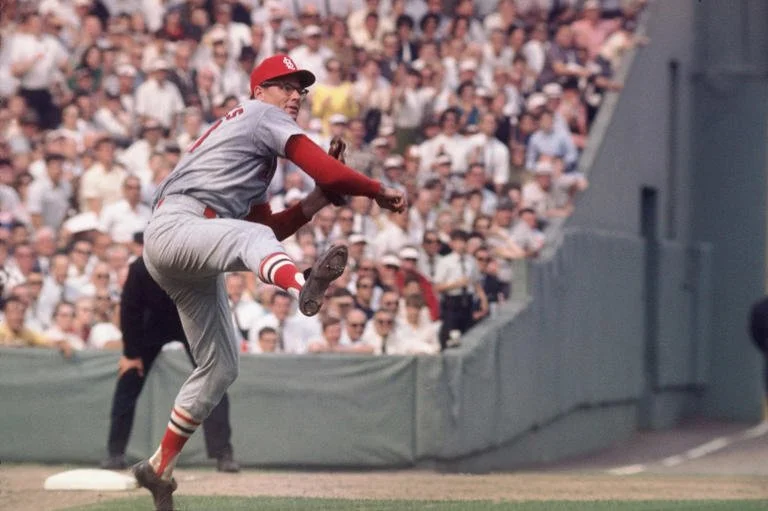
Cardinals rookie Dick Hughes pitches against the Boston Red Sox in Game 2 of the 1967 World Series at Fenway Park.
To every thing turn, turn, turn.
That lyric comes to mind now and then, as things turn. Thing turned quite a bit last week. I heard about Bob Skinner passing, and remembered seeing his pinch-hit drive hit the right-field screen on a bright Sunday afternoon at Grand and Dodier.
I get a suntan just thinking about it.
Skinner played most for his fine career with the Pirates, but he finished with the Cardinals, primarily as a left-handed bat off the bench. He hit his last homer in the final game at Sportsman’s Park/Busch Stadium in May 1966. That also came to mind.
Watching Skinner play, going to games with my dad at the old ballpark, are things from my childhood. Skinner’s passing underlined how that season has come and gone.
Later in the week, news came about Bobby Cox passing. As a beat writer, I would head to ballparks early and spend time talking baseball with the likes of Cox, Lou Piniella, Pete Rose, Whitey Herzog … when baseball had such characters and afforded such opportunities.
On one of the Braves’ trips into St. Louis, I was hospitalized with pneumonia. My colleague Rick Hummel called to let me know that Cox asked about me and passed along well wishes - something I’ll never forget. Hanging out in the manager’s office, getting to know its occupant, is something that turned a long time back.
Between all that sobering news came one more thought-provoking note - the passing of Dick Hughes. Again, the bespectacled Hughes was a page from the past, part of the iconic 1967 Cardinals and one of the great individual stories in baseball history.
On the front end, it is a tale of perseverance and triumph.
At 6-foot-3, 195 pounds, Hughes could bring it, even if he couldn’t always control it. In 1958, at scout Fred Hahn’s urging, the Cardinals gave the Stephens, Ark. native a tryout and, as Hughes recalled, he “struck out every guy that I faced.” Somewhere someone must have yelled, “Sign him up!” And they did.
From there, Hughes battled his control issues and bounced around the obsolete corners of baseball’s farm system, places like Keokuk, Ia., Winnipeg, Manitoba, Winston-Salem, N.C. and Wilkes-Barre, Pa. Added up, it was 10 different cities over nine different seasons, and winters in Puerto Rico and Dominican Republic.
There was even time travel involved - at Class AAA Portland in 1961, 55-year old Satchel Paige was his teammate for a couple of weeks.
By 1964, the resolute Hughes was 9-2 in July and dealing for Jacksonville (Fla.) - the Cardinals’ top farm club - when the parent club sought pitching help. That night, Hughes auditioned against Columbus and was hit in the arm by a line drive. He had to leave the game and forfeit his chance. The Cardinals called up Gordon Richardson instead.
But in 1967, at age 29, he made the big club in spring training. The gig started in the bullpen, but when starter Al Jackson struggled, Hughes got a hall pass to visit the rotation, and he made the most of it. He didn’t just become a starter, he became the team’s most reliable starter, going 16-6 with a 2.67 earned-run average.
Using a no-windup delivery that helped him corral his wildness, he allowed just 164 hits in 222. ⅓ innings, a hits-per-nine-inning ratio that led the National League. He completed 12 of his 27 starts, tossed three shutouts and even collected three saves out of the bullpen. The emergence took hold on May 25, when Hughes threw a two-hit shutout at the Braves. Five days later, he started at Cincinnati, struck out 13 and had a perfect game going for seven innings. He wound up losing 2-1, but his role was cemented.
Six weeks later, in the fourth inning of a game with Pittsburgh, Bob Gibson stopped a Roberto Clemente line drive with his right fibula. That’s not what those are for.
Gibson pitched to three more batters at Busch Stadium II - walking two - before his fractured leg said "enough." He was done for the day and, more consequentially, he was done for the next 7 ½ weeks. The Cardinals recoiled, losing the next two to the bottom-dwelling New York Mets. But in the series finale, Hughes took the ball and settled things down, beat the Mets and stopped the spiral.
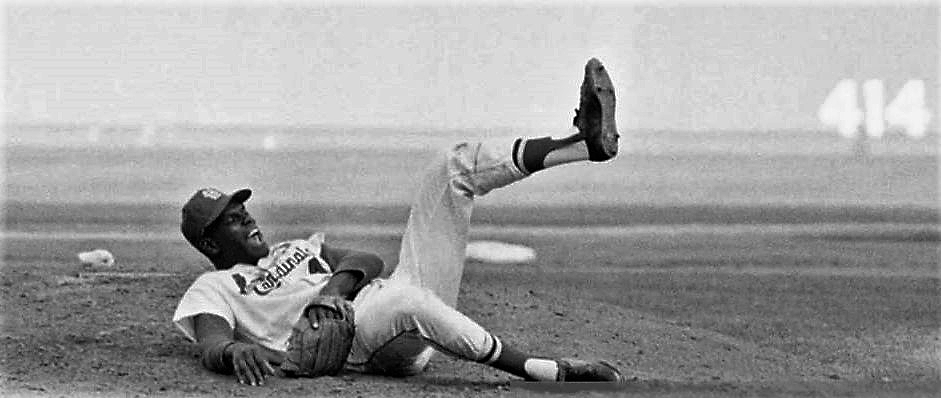
Bob Gibson goes down after being hit in the right shin by Roberto Clemente’s line drive on July 15, 1967 at Busch Stadium II. Gibson pitched to three more batters before leaving the game and missing 52 days with a fractured leg.
On that dark day of Gibson’s injury, the Cardinals were 51-34 and owned a four-game lead over both Chicago and Cincinnati in the NL race. Common sense suggested, with their future Hall of Fame ace in a cast, the season would capsize.
But when Gibson returned to beat the Mets on Sept. 7 in New York, the Cardinals were 87-53 and holding down first place by 11 ½ games. In his absence, the club went 36-19 on its way to a 101-60 record.
That’s not a typo. The Cardinals were 17 games over .500 with Gibson and 17 games over without him. Losing one of the most dominating pitchers in the game had zero impact on destiny’s darlings. In fact, they padded their lead by 7 ½ games. Huh? What? How is that possible?
Dick Hughes and Nelson Briles.
Both right-handers went 7-2 while Gibson was sidelined, a combined 14-4 during the 52-day stretch. And, after all those years of bad motels and banged-up buses, Hughes started Game 2 of the ’67 World Series against the Boston Red Sox. It wasn’t a fair fight. Jim Lonborg threw a one-hit shutout and the Cardinals lost 5-0. But Hughes did his part, allowing one earned run in 5 ⅓ innings, a line that earns high marks in today’s press boxes.
In the end, Hughes’ improbable ’67 season fortified the notion - at least for those who prescribe - that baseball’s media is poisoned with east coast bias. For when the writer’s announced the 1967 MLB awards, 22-year old Mets phenom Tom Seaver was the NL Rookie of the Year. And it wasn’t even close, as Seaver got 11 first-place votes and Hughes got six.
Now, this is not an exercise to compare the careers of Hughes and Seaver, because they don’t compare. Seaver is on the short list of the greatest pitchers ever, with 311 wins, 61 shutouts and three Cy Young awards. His peers are Gibson, Koufax, Spahn, Marichal … last names that don’t require first names. Dick Hughes does.
This also is not to suggest Seaver’s rookie season was not worthy of accolades or acknowledgement, certainly it was. But this isn’t about lists, careers or names. This is about one season - 1967 - and one recognition - Rookie of the Year.
In ’67 Seaver was 16-13 with a 2.76 ERA, a Mets record for wins and a harbinger of better days ahead. Wes Westrum’s Mets were lousy, 10th-place finishers in a 10-team race. You might wonder, where would they have been without Seaver? Well … they would have been 10th.
Had Seaver pitched for St. Louis, who knows what his record would have looked like. Seems reasonable to believe it might have been better. But here’s the thing - he didn’t pitch for the Cardinals; he pitched for the Mets.
Was he a victim of tough luck in that respect?
Well, Seaver was 3-8 in starts where his team scored two or fewer runs. Hughes was 3-6 under such circumstances. Seaver had seven one-run losses, Hughes had four such losses. You know the old saying - seven of one, four of the other.
Meanwhile, Hughes was 7-0 when his team gave him 3-5 runs of support, while Seaver was 7-4. In short, the “inside baseball” personality of their records was not dramatically different.
On the other hand, Hughes was the leading winner on a staff that included Gibson, Steve Carlton and Ray Washburn. He was a remarkable 9-2 on the road, opposing hitters batted just .203 against him and he led the league with a 0.954 WHIP), that is, walks and hits per Innings pitched.
Seaver was 4-8 on the road, opposing hitters batted .241 and his WHIP was 1.203. Hughes had three shutouts, Seaver two.
To be sure, Seaver was a dynamic young pitcher, a young Sir Galahad at a wobbly Mets table. He not only threw hard, he looked the part doing it. Hughes looked like he should be wearing a lab coat.
But by “Of the Year” parameters, Hughes’ story was the story. He was a 29-year old survivor of baseball’s hinterlands. He had 20-350 vision in one eye and 20-375 in the other. He worked a cattle ranch with his dad, yodeled and played country songs on his guitar. He once brought a rifle for hunting on a Cardinals trip, carrying it on his shoulder from the bus to the plane.
And he never gave up. He became an integral reason why the Cardinals withstood the loss of their meal ticket and won a magical championship. Orlando Cepeda’s “El Birdos” were 20-7 in games he started. They would have been “El Buried-o” without him.
Was he as sexy and exciting as ”Tom Terrific” in New York? More like “Floyd” the neighborhood barber. But how in the world was he not the Rookie of the Year?
The Sporting News - aka “The Bible of Baseball” - knew a good story when it saw one - and vice versa - and it underscored the bias narrative by naming Hughes as its NL Rookie of the Year. The announcement suggested that when it came to baseball writers awards, three factors were most important - location, location, location.
But there is a back end to Hughes’ story, one that flips the rags-to-riches script. In 1968, making his final tuneup start in spring training, Hughes felt something in his right shoulder and came out of the game. He tried pitching through it when the season started. But in his first start, he allowed 6 runs in just 1 ⅔ innings. In his next attempt, he lasted only 2 ⅓ innings. He had a rotator cuff tear.
In today’s world, with today’s advancements, it’s a treatable issue. In the late ‘60s, it was a baseball pitcher’s death sentence. Hughes took cortisone shots, tried resting, prayed a lot.
But he was never the same. As he told the Post-Dispatch years later, “I placed my faith in the Lord and the doctors, but it just didn’t work out.”
He made only five starts in ’68, pitched 63.2 innings and finished 2-2 with 3.53 ERA. He tried again in ’69, making 15 appearances in Class A ball, but it was no use. At age 31, less than two years after being among the best in the big leagues, he was done.
Hughes, whose top salary was $26,000, didn’t even qualify for a pension by having four years of major league status. But in the end, he didn’t dwell on it. Yes, he sometimes wondered what might have been. But he also attended reunions and saw what had become of some of his contemporaries.
He had his cattle business, farmed tomatoes, and made some money off the occasional card show. He had his wife, his two sons and three grandchildren. He had a long and successful career … in life.
After all those years, he made it. He led the ’67 Cardinals in wins, played in a World Series, and fulfilled a dream. The baseball writers could give someone else a Rookie of the Year honor, but they couldn’t take that away from him. He felt it each spring.
“Each spring, I still feel like I’m in the wrong place,” Hughes said once. “It’s nostalgia. There’s nothing you can do about it. If you’ve competed in athletics during your life, you understand the feeling.
“You get to your season and the body just seems to tell you that you should start playing your game.”
To every thing, there is a season. We’ll never forget yours, Dick Hughes.