Parayko In Good Company With Stan The Man
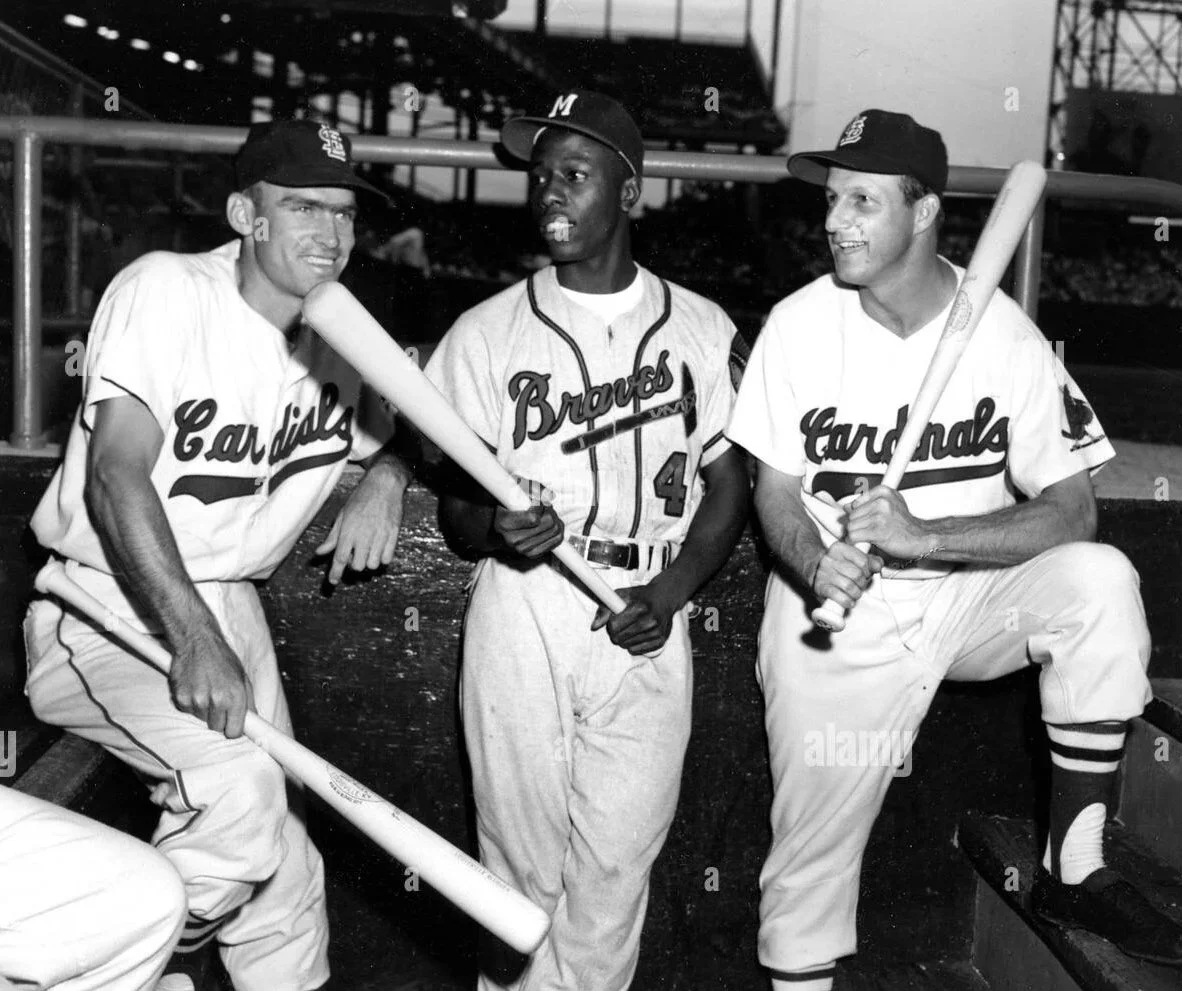
Wally Moon (left) and Stan Musial (right) are pictured with Henry Aaron (center) before a game in 1956. Moon and Musial are wearing the re-designed Cardinals uniform, without the birds on the bat.
Here’s hoping Colton Parayko didn’t take it personal.
If you recall, the Blues attempted to move the big defenseman at the NHL trade deadline last March. When the news leaked, all of St. Louis - including those who were giddy about the return package - knew the deal hinged on Parayko’s approval.
But Parayko has been in St. Louis for 11 years, part of the organization even longer. He likes it here, and spends most of his summer here. He’s part of the community, part of the Blues family and when he was asked to move to Buffalo, he declined.
That’s right, he chose not to move to Buffalo. Can you imagine?
The whole affair was awkward and unfair. But Parayko should keep it in perspective. After all, back in the days before “no-trade language,” rejected trades impacted the biggest of St. Louis sports names. No really, the BIGGEST!
That’s to say, would you believe, on more than one occasion, Stan Musial was on his way out of town?
In October 1955, less than three years after Anheuser-Busch purchased the Cardinals, president August A. “Gussie” Busch Jr. hired Frank Lane as his general manager. To that point, the baseball operations had been handled by Dick Meyer, a carryover from the brewery, a fine businessman, not a baseball man.
Lane, on the other hand, was an experienced team executive. Moreover, he was baseball’s version of Monty Hall, an unabashed personality who enjoyed the spotlight and made trades like it was a bodily function. During seven previous seasons with the Chicago White Sox, Lane consummated 253 deals and moved a total of 341 players, a pace that would have made Whitey Herzog blush.
In the process, “Trader Lane” transformed the downtrodden, dysfunctional Sox into winners. Chicago went from 60-94 in 1950 to 94-60 in 1954. That was the hook Busch swallowed.
For their part, the Cardinals had been stuck in what Johnny Rivers called ”the poor side of town.” From 1954-55, the club was a combined 28 games under .500 and 55½ games out of first place. The dissatisfied Busch didn’t just hire Lane, he gave him full authority to make whatever deals he deemed appropriate. As things turned out, that was kind of like handing Tiger Woods the keys to the car.
Among the first things Lane did was re-design the team’s iconic uniform. For the 1956 season, the traditional birds-on-the-bat gave way to a scripted “Cardinals” across the chest. Eat your heart out Harry Ornest! (See Blues uniforms 1983).
The Cardinals new fashion statement was not especially well received and lasted only one season. To put that in baseball vernacular, it was a swing and a miss.
But Lane was just warming up. In early May, 1956 he traded pitchers Harvey Haddix - 50 wins over the previous three seasons - and Stu Miller to Pittsburgh. In return, he received the mummified remains of pitcher Murry Dickson - 39 at the time - and pitcher Herm Wehmeier.
Haddix, by the way, had been one of six Lane had identified as “untouchables” when he arrived in town. The others were Stan Musial, Red Schoendienst, Ken Boyer, Bill Virdon, and Wally Moon … but we digress.
Three days later, Lane shipped Solly Hemus to Philadelphia for Bobby Morgan. Two days after that, shortstop Alex Grammas and utility man Joe Frazier went to Cincinnati for someone named Chuck Harmon. The outfielder would make 20 plate appearances as a Cardinal and bat .056.
One day later, Lane sent the 1955 National League Rookie of the Year, center fielder Virdon, to Pittsburgh for outfielder Bobby Del Greco and pitcher Dick Littlefield. Del Greco was a bust, while Littlefield was included in a deal that sent future Hall of Famer Red Schoendienst to the New York Giants for Alvin Dark.
That trade-deadline move sent shock waves down Grand Avenue (where Sportsman’s Park/Busch Stadium stood), and dispirited Musial, who was especially tight with Schoendienst. But if that development stunned Musial, he should have seen the one that got away. That is, before sending Schoendienst packing, Frank The Trading Tank was tying the knot on a trade of No. 6 to Philadelphia for Robin Roberts.
A future Hall of Famer, Roberts was the best pitcher in the NL at the time. From 1950 through 1955, he averaged more than 22 wins, 323 innings and 27 complete games.The Springfield, Ill. native was 28-7 in 1952, the first of four consecutive seasons that he led the league in wins. In short, getting traded for that thoroughbred - who was 28 years old at the time - was no indignity.
But this was Stan Musial, baseball’s “perfect knight,” synonymous with St. Louis and the Cardinals. And yet, if not for St. Louis restaurateur Julius “Biggie” Garagnani, and Busch consultants like PR man Al Fleishman, it almost certainly would have happened.
Garagnani was a close friend and business partner of Musial. Their restaurant - Stan & Biggie’s - operated here from 1949-86. Garagnani also was well-connected. Upon getting wind of the pending trade, he called Sporting News publisherJ.G Taylor Spink and confirmed it was in the works.
Unable to contact Busch directly - and perhaps just a little concerned about the future of the restaurant - Garagnani took matters into his own hands. Before consulting with Musial himself, Garagnani called team officials - maybe Fleishman - and assured him that the 35-year old “Man” would retire rather than go to Philadelphia.
Whether Musial would have honored that threat seems a bit dubious, given he was just 45 hits shy of 3,000 on June 15, 1956. Nonetheless, when Busch was made aware of the situation, he shut it down. On June 10, on Busch’s orders, Lane phoned the Post-Dispatch to deny the whole affair.
“This is to set at rest any idea that Musial is available to any club, East or West,” Lane said. “And I know that Mr. August A. Busch is 100 percent in accord with me on this. It’s just wishful thinking on the part of somebody in the East.”
You could almost hear pathological liar Tommy Flanagan in the background: “Yeah, that’s the ticket, that’s what it is, ‘wishful thinking.’ ”
With the Musial move scuttled, the relentless Lane completed the Schoendienst deal on June 14. Afterwards, a seething Busch slapped a governor on Lane, demanding he get approval on any future trades.
To be fair, as the moving trucks came and went, the club did improve under Lane. The Cardinals won 76 games in ’56 and improved to 87 wins and a second-place finish in ’57. Moreover, that team was in first place after beating the Phillies in the second game of a doubleheader on Aug. 4 - with Dark going 3 for 4. Nine consecutive losses later, on Aug. 15, they were eight games out.
There was a method to Lane’s madness, or so it seemed. But make no mistake, it was madness. Lane’s assistant during his GM tenure, Bing Devine, often credited his mentor for teaching him the art of the deal - even if the art was slightly chaotic.
“If Frank Lane didn’t make a deal in a month, he’d be nasty, just like a smoker who needed a cigarette.” Devine recalled in his memoirs.
As the ’58 season approached and his three-year contract was coming due, Lane asked for an extension - he was rebuffed. With his green light rescinded, and his future open ended, Lane became increasingly disenchanted. And the final straw was another sabotaged trade.
This time, Lane worked up a deal with Pittsburgh to swap 26-year old Ken Boyer - who moved from third base to Virdon’s center field vacancy in ’57 - for slugger Frank Thomas and third baseman Gene Freese. But when Lane followed protocol and took the deal to Busch and advisors, the answer was “no.”
Lane, who felt Boyer was underachieving, kept trying. He offered Boyer to the Phillies for center fielder Richie Ashburn and Haddix - the little lefty he dealt away two years earlier.
As an aside, think of the ramifications of that trade. Boyer became the 1964 MVP when the Cardinals squeezed past the imploding Phillies to win a championship. What might have happened had the shoe - i.e. Boyer - been on the other foot, or team?
But in the midst of the discussions, the frustrated Lane jumped ship and took the GM job in Cleveland. His unfettered authority restored, he went on to wreak havoc with the Indians, trading away the likes of Rocky Colavito, Norm Cash and Roger Maris. In 1958 alone, he moved 42 players.
By Aug. 3, 1960, Lane’s tinkering morphed from frenzied to farcical, when he traded managers with the Detroit Tigers - Joe Gordon for Jimmie Dykes.
You can’t teach that.
Meanwhile, upon Lane’s departure, the Phillies doubled back on Boyer talks with his successor, Devine. But “Der Bingle” wasn’t having it. Pittsburgh also made another pass, offering former Cardinal Virdon and Freese. But Devine closed shop on the Boyer Business.
As for Musial, other trade rumors marked his career. For instance, in 1949 the cash-poor Cardinals were said to be considering selling Musial and Dickson to the Pirates. In fact, they did sell Dickson for $125,000. Whether they discussed Musial remained a mystery. Given Musial’s performance in 1948 - leading the league in batting (.376), runs, hits, doubles, triples and RBIs - falling one home run shy of a Triple Crown - it could be the price was too rich for Pittsburgh.
In his book with Post-Dispatch sports writer Bob Broeg, Musial said he considered asking for a release before the trade deadline in 1960. At that point, he was benched by manager Hemus and word got around that his hometown Pirates were interested in signing him. It never happened.
And how about this one: In August 1959, Spink penned a front page Sporting News story insisting Musial was to be traded to the New York Yankees for catching star and St. Louis native Yogi Berra. “Musial to Yanks — Berra a Redbird,” the bold headline trumpeted.
Spink wrote, “Both clubs may deny that the deal is in process or that there is any thought of it. But The Sporting News’ authority states convincingly that the trade already is in the works.”
The idea wasn’t completely crazy. The 38-year old Musial was halfway through the worst season of his career (.255) and, likewise, the 34-year old Berra was on the backstretch. But, despite Spink’s assertion, the swap never materialized. As predicted, all parties denied it ever existed.
Did the Sporting News, aka the “baseball bible,” get it wrong? Was a Yankee outfield of Musial, Mickey Mantle and Roger Maris ever a real possibility? As the paradoxical Berra might say, maybe “it was over before it was ever over.”