The Day Stan Musial Pitched
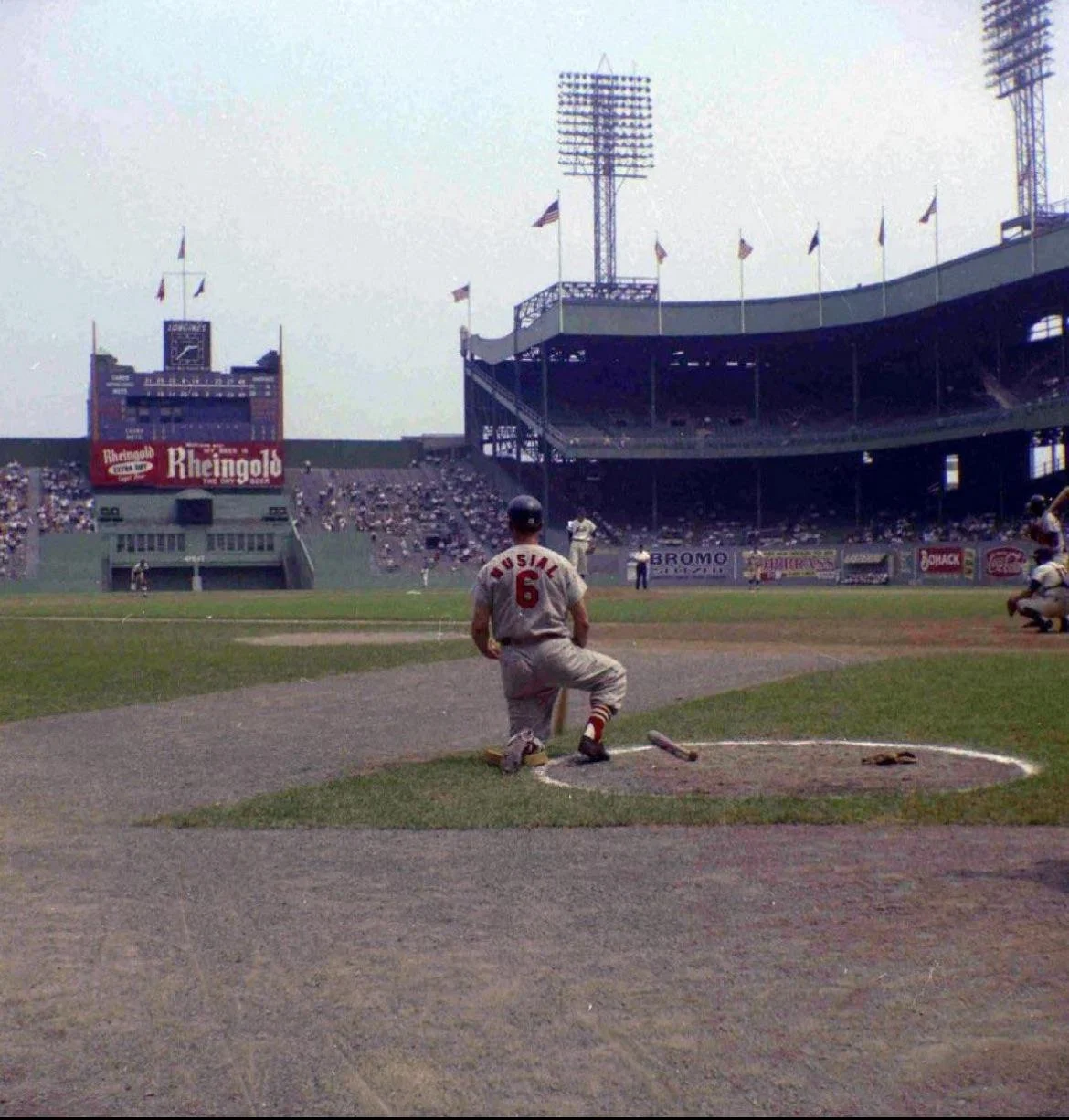
Stan Musial kneels in the on-deck circle as the Cardinals play the New York Mets at the Polo Grounds..
It never would have happened.
That is, Stan Musial did remarkable things in his baseball career, which spanned from 1941-1963. By the time he bounced his final hit past Pete Rose, shook hands with pinch-runner Gary Kolb and trotted off into the sunset of Sept, 29,1963, Musial held or shared 17 major league records, 29 National League records and nine All Star Game records.
Plenty of accolades go with the ledger, authentication from the most credible sources - his peers. A personal favorite is associated with Ty Cobb, who was not known for being fast and loose with compliments, regarding friends or foes.
But Cobb once took issue when asked to compare Musial and Joltin’ Joe DiMaggio. “Stan Musial is a better player than Joe DiMaggio was in his prime,” Cobb said.
Coming from an American League guy, that’s something.
At the same time, an arbitrary piece of Musial’s robust major league career has all but disappeared, buried beneath the avalanche of line drives and harmonica riffs. When you dig it up now, all these years later, you realize it would never happen in today’s major leagues.
That is, “Baseball’s Perfect Warrior,” among the greatest players the game has ever seen, would not also be among its most obscure pitchers.
These days, a pitcher entering an MLB game must face at least three batters, or finish a half inning. But that wasn’t the case on Sept. 28, 1952, when Musial took the mound to throw the first, last and only pitch of his big league career.
And to be Frank, or to be Stanley Frank, Musial would not have agreed to more.
Baseball fans familiar with Musial probably know he started as a pitcher, although not a particularly promising one. He was lefthanded, had that going for him. He had a good arm, and when it directed a baseball at or near the plate, he could be effective. “When” was the operative word.
“If you had the best arm in your school, they made you the pitcher,” said Musial, who passed away at age 92 in 2013. “So I pitched once in a while as a kid, but I never really liked pitching, never had much confidence in myself. I was kind of your typical wild left-hander.
“I would never have been a Warren Spahn, that’s for sure. I would walk eight or nine guys in a game, and I would strike out 12 or something.
He then added, with his cackling, ever-present, self-deprecating laugh. “Put it this way. When I pitched, the games took a long time.”
From 1938 to 1940, across his minor league pitching career, Musial issued 310 walks in 425 innings. It wasn’t just that he couldn’t hit the broad side of a barn - he couldn’t hit the property it was on.
In 1939, Williamson Red Birds manager Harrison Wickel became so frustrated with the scattershot southpaw, he wrote Cardinals executives to recommend they release him. In the letter, Wickel explained Musial was "the wildest pitcher I have ever seen," but noted he "could hit a little."
Things improved in 1940. Musial went 18-5 with a 2.62 ERA at Class D Daytona Beach - he also walked 145 in 223 innings. Meanwhile, another door opened.
Class D was the lowest form of professional baseball at the time, and Daytona manager Dickie Kerr had only 15 players on his roster. To cope, Kerr used Musial in the outfield when he wasn’t pitching, and the 19-year old responded with a .352 batting average.
Late in the season, making a diving catch, Musial hurt his left shoulder. When he reported to Hollywood, Fla, the following spring, the shoulder still wasn’t right. Exasperated Cardinals executive Branch Rickey was prepared to cut bait until seeing Musial crush a long home run in an intrasquad game.
Springfield skipper Ollie Vanek had managed in Monessen, Pa, near Musial,’s hometown. He remembered the “Donora Greyhound” from those Mon Valley days and he proposed carrying the misfit pitcher on his Class C roster. Rickey relented.
In 87 games at Springfield, Musial batted .379 with 26 homers and 94 runs batted in. He catapulted to Class AA Rochester, where he hit .326 in 54 games. To cap things off, the kid with the dead arm and the lively bat spent his last 12 games of 1941 with the St. Louis Cardinals, batting .426 in his big-league debut.
That closed the curtain on Musial’s career as a pitcher … or so it seemed.
But late in ’52, eliminated from the pennant race, the Cardinals hosted the Chicago Cubs in the series the season, and the front office saw a chance to sell more seats for the Sunday finale.
With a .336 average, Musial had all but clinched a third consecutive batting title - the sixth of seven overall - as the game approached. That said, Cubs outfielder Frank Baumholtz - who had more than 150 fewer at-bats - was up to .332 and retained a mathematical chance of catching or surpassing the leader.
For lighting to strike, Baumholtz needed to go 5 for 5 or better at the plate, while Musial had to go hitless in at least four at-bats. Given the Cardinals were starting left-hander Harvey Haddix, given the left-hand swinging Baumholtz was batted just .243 against lefties, given Musial was nine for his last 23, it was far-fetched at best.
Still, Cardinals brass could read the promotional tea leaves and they knew just how to thicken the plot. They asked Musial to dust off the old soup bone, take the hill and face his adversary, Baumholtz. You know, mano a mano, or should we say, “The Man” to the other man.
Musial was not enthused about playing part in the charade. In his autobiography, Stan Musial: “The Man’s” Own Story, Musial told Bob Broeg, “I didn’t relish the contrived show… I didn’t want to give any impression I might be trying to show (Baumholtz) up.”
He eventually caved, agreeing only to pitch to Baumholtz in the first inning … not three batters … not a half inning … one and done. Thus, on a lovely fall Sunday in St. Louis, Musial made his pitching debut.
He did so wearing his Cardinals cap straight, in the standard fashion. But then he was only Stan Musial, not Hancel Rincon.
When Haddix started the game by walking Chicago’s Tommy Brown, the wheels went into motion. Cardinals manager Eddie Stanky emerged from the dugout and - foreshadowing Whitey Herzog in the 1980s - Stanky made an unorthodox pitching change. He sent Haddix to right field, shifted right fielder Hal Rice to center and summoned center fielder Musial to the mound.
Herzog pulled a similar move several times as manager of the Cardinals when he temporarily sent right-handed pitcher Todd Worrell to the outfield, then brought him back. But we digress …
On this occasion, Stanky handed the ball to Musial, gave him a pat on the rump and headed back to the dugout. Oh, he also offered a bit of encouragement before he departed.
“Stanky told me, ‘If you walk him, it’ll cost you $50,’” Musial recalled.
Musial, the best player in the NL, was making $80,000 at the time. And fifty bucks was fifty bucks.
Meanwhile, according to Danny Peary’s book, We Played The Game, skipper Phil Cavarretta tried to stir the pot from the Cubs dugout. “They’re trying to make a fool out of you, Frank,” he yelled to his on-deck hitter.
Give Cavarretta credit, anything to fire up his player. But those who knew Musial, teammates and opposing players alike, knew it couldn’t be so. “Baseball’s Perfect Knight” would never stoop to such nonsense. Baumholtz knew the theatrics were a club-orchestrated gimmick, a way to spice up a meaningless final game of the season.
When Musial was done with his two warmup pitches - that’s correct, he took two warmup pitches - Baumholtz joined the fun and evened the playing field. He knocked the dirt from his cleats and stepped into the box on the right side of the plate - his first, last and only at-bat from the right side.
Musial’s shoulder strength never fully returned after his injury in ’40. He had good running speed, played a fine defensive outfield. But his throwing arm was ordinary. And he wasn’t going to extend the shenanigans by getting tricky.
He went into a stretch and - in his words - “flipped” a pitch toward the plate.
Likewise, Baumholtz wasn’t interested in extending the affair. A walk would only undermine his batting crown aspirations by robbing him of an official at-bat. Therefore, he went to hacking, and slammed a hard grounder to third. Solly Hemus - a shortstop by trade - was making just his second start at third for the Cardinals and a high hop ate him alive. Hemus recovered the debris, but his throw to first was late and wide. Baumholtz reached and Brown hustled all the way to third.
The official scorer ruled an error on Hemus, while United Press International said the tough chance “should have been a double play ball.” Wanting no favors, Musial called up to the press box later and tried to get the error changed to a hit, to no avail.
Maybe Hemus held it against Musial. That would help explain why, as Cardinals manager, he controversially benched the Hall of Famer in 1960.
Call it a theory
On the other hand, defense was never Solly’s strong suit. At the plate, he was a tough out, a .273 hitter with a career on-base percentage of .390. At shortstop, he was Ivan Drago. Hemus had 29 shortstop errors in ’52, then led NL with 27 the following season.
His double-play partner at second base, Red Schoendienst once descried Hemus in this manner: “He wasn't a great shortstop but he got the job done … Maybe it wasn't the best, but he always was trying to help the club.”
Sounds like my mom describing my efforts as a dishwasher. Put it this way, where the old Redhead is concerned, that’s about as close to a shot as you get.
With the Baumholtz battle concluded, the big-league pitching career of the celebrated No. 6 came to a perfunctory end. Stanky ascended the dugout steps. Haddix returned to the mound. Rice shifted back to right field and Musial trotted back to center, free to terrorize pitchers, not impersonate them.
“I just wanted to get it over with,” Musial said afterwards.
Admittedly, it wasn’t much. One pitch. But like everything Musial did, the pitch by “The Man” was damned effective. The unremarkable offering generated the error and sabotaged the batting title mathematics. The game wasn’t even an inning old and Baumholtz wore an 0 for 1, his champagne wishes and perfect-day dreams vanquished. The $50 never changed hands.
The current Cardinals might also point out that Musial protected his lead while limiting his pitch-count to ONE, leaving bullets in the chamber should he have to face future batting championship contenders. Meanwhile, the 17,422 that came witnessed the novelty act and 3-0 Cubs win, represented an increase of some 5,500 over the average attendance for the season.
In the end, for his part, Musial didn’t even bat four times. He lined a single to left in the ninth, went 1 for 3 and claimed the batting crown at .336. Baumholtz also didn’t get the five at-bats his insurrection required, much less the five hits. He finished the day 1 for 4, with a bunt single, and finished the season at .325.
Interestingly enough, through a stellar 10-year career, which included a .290 average and 1,010 hits, Baumholtz never had a five-hit performance. There was a better chance of pigs flying.
And as you realize the 2026 Cardinals might not have a regular bat as high as .280, consider that Musial’s 1952 average - which led both leagues - was the lowest of his seven batting championship averages.
In 1952, the 31-year old also led the NL in slugging percentage (.538), hits (194), total bases (311), doubles (42), OPS (.970) and shared the lead in runs (105) with Hemus. Oh, and he struck out 29 times in 578 ABs.
What’s more, it was the 11th of 17 consecutive seasons of batting over .300 for the good-hitting pitcher.
And when it was over, when the shadows fell on that Sunday afternoon and Musial put away his pitching past for good, he apologized.
“I had a bad year; I wish I could have done better,” he said after the game. “My timing was off during the season.”
Safe to say not many people remember Stan Musial as a pitcher. You don’t ever forget a guy like that as a ballplayer.